
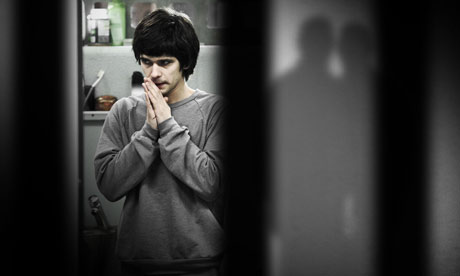
In this scene from ‘Criminal Justice’, a one off BBC drama, the main character, “Ben” gets into a fight with another prisoner. “Ben” is struggling in the fight and so the fight is ended after another prisoner, “Hooch” who we see as a sort of anti-hero, punches the in-mate that “Ben” is fighting. It then turns out that “Hooch“ had actually betrayed “Ben” which caused the fight in the first place. Prison is represented using many different techniques such as, mise-en-scene, editing, camerawork, and sound and music. These four areas work together to generally show prison to seem a lonely, dark, violent and unjust place.
The mise-en-scene is perhaps the most important factor to show the representation of prison in this extract because mise-en-scene is what creates verisimilitude. The setting in the extract is very plain with dull colours of grey and light blue. The prison walls match the same colour as the in mates clothes, however character is established as the clothes of the villain is slightly darker than the rest. This suggesting that he is different to everyone else, and he stands out. The lighting in the mise-en-scene is important, as there are lots of shadows. The group with "Ben" approaches are stood in a dark shadowed corner, and when the villainous character is speaking there are shadows on half of his face to build up enigma and suspense. The colour scheme is focused on more when the scene moves on to the fight starting and the villain takes a red chair to sit on and watch the fight. Everyone else is standing which again supports the idea that he is different and more authoritive than the other prisoners, and the red colour suggests danger. Costume is also important in this extract, because the bald character is made to look 'thuggish' through his appearance and clothes. He has a shaved head and is wearing a hoodie, which we immediately associate with anti-social, thuggish personalities. He also doesn't speak, which again builds enigma and suggests mystery, and danger. The most obvious is the fact that he is involved in the fight on the timid looking "Ben", which could suggest a sort of bullying, and the fact that he is fighting also supports the "thug" representation, which is commonly associated with prisons. "Hooch" is wearing a cardigan, which supports the idea of him being old, and with age comes wisdom. The policeman at the far end of the hall is shown to be wearing a very clean, white shirt, and he looks smart and well respectable. However, this is ironic because he is infact a corrupt cop, and keeps quiet about the fight that has taken place. Overall the set design is a very stereotypical prison, plain place, which is enclosed and seems like a very isolated place.
Editing is probably the second most important factor to show how prison is represented in this scene. The editing also helps to establish character, as the first shot of "Hooch" is shown in a light room whilst in contrast it shows the other villainous characters in the dark corner. This suggests that there is a certain degree of safety in "Hooch". Most of the shots are filmed with a shaky hand held camera, and there is more shaking whenever "Ben" is in the shot, this could represent his fear, or nervousness in this confrontation. The villain character is less steady, but it begins to become shakier when he becomes more angry. There are lots of deep focus used to direct the viewers attention to the important features, such as the reactions in certain parts of the scene, like when you can see the fight going on in the foreground, and then in the background un focused you can see the policeman stood watching, doing nothing at all.
Another aspect is the camerawork. The first shot is a tracking shot where the camera is postioned at one end of a corridor, and is tracking "Ben". This instantly establishes character, as you know by following "Ben" that he is the main character in the scene, and that he will be involved in something. Slightly further on in the scene there is a close up of the villain character with the phone in his hand. The phone becomes a motif at that point, and it is clear to the viewer that the scene will revolve around the phone somehow. Before the fight, there is an eyeline match from the villainous character which shows him looking at the thuggish character. This eyeline match builds enigma and suspense, and the viewer knows that something is about to happen. The fight is then filmed with a hand held shaky camera, which supports the uncertainty of the fight. "Hooch" is then showed to punch the thuggish character who is winning the fight with ease, and essentially "Hooch" saves "Ben". There is a cutaway to the policeman's reaction after this punch, and his reaction suggests that "Hooch" shouldn't have done that, and that something is wrong now. It then cuts to the villainous character's reaction, and this confirms that suggestion.
Finally, sound and music is the final factor that represents prison in the scene. The first piece of sound you hear is an eery atmospheric sound, that instantly creates tention. This builds enigma as it works with the tracking shot of "Ben" walking down the corridor. There is then amplified dialogue between "Ben" and the prison guard, it is amplified so that you can hear the speech clearly, but also hear the atmospheric sound which is still creating tention. As "Ben" walks through the hall towards the other prisoners you can hear a non diegtic, amplified sound of the phone being flicked in the villain character's hand. There is then just dialogue on its own, before the sound of the chair being moved is amplified. As you see the chair being moved, you can hear a high pitched frequency noise which again builds enigma just before the fight starts. There are then amplified punching sounds, which helps support the visual fight, whilst at the same time you can hear whilsting and jeering from the crowd of prisoners. Then the crowd noise fades out and on it's own "Hooche's" punch is amplified to suggest that it was important as it was the only thing you could hear. The next thing you can hear is non diegetic, distant prisoners laughing, which helps create verisimilitude, and supports the idea that the prison is bigger than what you can see. Then fades in the same incidental, eery non diegetic sound which is part of the score, which gives a threatening feeling.
Overall each aspect helps to represent prison in this extract, as the sound supports the camerawork in editing by making it more realistic, and creating enigma. Whilst the camerawork shows the realism and what is actually going on in the prison, and is supported by the editing. But the mise-en-scene is probably the most important as it actually creates the verisimilitude through the each aspect such as costume, lighting, acting, props and the set design.

Incomplete. See me.
ReplyDelete