Monday, 30 November 2009
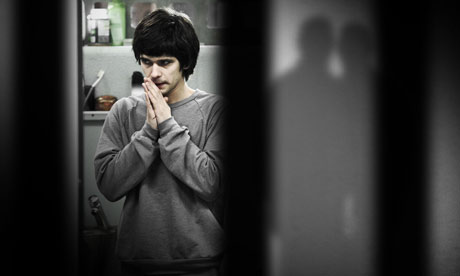
How is prison represented in the extract?
Tuesday, 10 November 2009
Sound/Music Evaluation
The task was to plan and produce a 48 second piece of sound that would go with the clip of an intergalactic TVD. We used a program called garageband, which allows you to create entirely original pieces of sound, with numerous effects and tools. We planned our piece by using a sound map to show what sounds we were going to use, at exactly which times to put them, and also the volume at different stages.
I used many techniques, and one of them being, perhaps the most important was ambient sound. My ambient sounds included an alarm, I was looking to create a sense of panic, and as the first thing you could hear was an alarm, this would be creating that sense almost instantly. You can’t actually see the alarm going off at any point in the clip, so it also becomes a non-diegetic sound. Another ambient sound I put in was an outer space ‘whooshing’ sound, as if a space ship had just flown by. This was to reinforce the idea of where the clip is set, on a space ship, in outer space.
Another technique I used was dialogue. The dialogue was very important as it made up almost half of the clip. When the characters were speaking, I lowered the volume of the ambient alarm to show that although they were talking, that sense of panic still remained. I recorded the dialogue through the built in microphone on the Mac.
Once the dialogue had finished, the clip showed the main character with a sense of fear on his face. Just before the dialogue had completely finished I faded in another more dramatic ambient “whooshing” noise, fading in from silent to full volume, drowning out the alarm. I wanted to reinforce that there was a much more dangerous sense of panic other than the alarm.
Overall, I think that my sound piece was simple, yet effective. The timings were good and the effects that I have created link well with what you are watching. I am very happy with it.
Monday, 2 November 2009
Sound and Music in TVD Clip
Sound & Music in "How Not to Live Your Life"
[0:31-2:31]
At 0:31 you can hear and see diegetic sound as 'Don' begins to play the guitar and sing the song, as this happens it creates a sense of realism, as if 'Don' has actually written the song, and obviously shows he can play and sing it.
At 1:03 'Eddy's' dialogue is slightly amplified so that you can hear him trying to get 'Don's' attention, however 'Don's' singing is still the same volume so that the audience can still hear the song even though 'Eddy' is speaking. This also creates the sense that 'Don' can't hear 'Eddy' over the song.
At 1:06 'Don's' singing gets louder to signify that he is getting carried away with the song. 'Eddy's' dialogue also gets louder to keep the same sound levels as before.
At 1:31 the theme tune comes in. This is the same theme tune that is on the opening credits, and closing credits. It is also a motÃf for 'Don's' cut away "What not to's".
At 1:41 when 'Don' clicks his fingers the click sound is amplified so that the audience don't miss it. This reinforces 'Don's' authority.
At 1:47 there is another example of diegetic sound, where you can see 'Don' eating in a ridiculous way, and the sound that he is making is amplified to reinforce how ridiculous his action is.
At 2:16 the noise of 'Don' closing the door is amplified, and it is also a diegetic sound, as you can see him closing the door, and also hear it.
At 2:27 the theme tune comes in again to show the end of one scene and the beginning of another. This is also kown as a sound bridge.
Wednesday, 14 October 2009
Explain how representations of family are created in the shown extract of Shameless (Series 1 Episode 5) [37.23 – 40.00]
The clip starts with “Frank” staggering home and a car creeping onto the screen almost stalking “Frank” on his way down the road. The camera then cuts to track “Frank” as he comes around the corner, and then the music starts to get faster and heavier as the car comes into view again, and at the same time getting faster. “Frank” stumbles onto the road and there is a long shot showing the car come behind him. “Frank” gets out of the way of the car, and the driver (still unknown at this point) crashes into the side of a parked van, this sequence shown by a series of fast cuts from different camera positions. Match on action is also used here to build a feeling of danger and show a fast pace. A hand held camera shaking cuts to a close up of “Frank's” face to show his reaction as he looks who the driver is. His expression is shock as the camera cuts to “Philip” running towards “Frank” on the floor. His expression is shock, because he realised that it is his son who attempted to run him over, and who is also running towards him with rage. These shots show a POV shot from “Frank's” perspective as he watches “Philip” run towards him, and an over the shoulder shot from “Philip's” perspective as he is running.
The next shot is the start of the fight scene where “Philip” is punching his Dad whilst he is on the floor. There are lots of short, fast cuts here between punches showing different points of view, “Philip” giving the punches and then “Frank” receiving them. Whilst the fight is going on, there are cuts to the house where “Sheila” and “Karen” are, and they realise that it is “Philip” and “Frank” having the fight. The music is still playing to build a sense of urgency from the women's point of view.
The fight is then broken up, and there are constant cuts between “Frank” and “Philip” as they are separated, the camera used is a hand held camera and is shaking quite a lot to show how distressed they both are after the fight. The fight scene reinforces the idea of the “Gallagher” family being dysfunctional, as they have just had a fight in the middle of the street.
The clip then cuts to an extreme close up of “Frank” lying on “Shelia's” sofa showing the wounds on his face after the fight. The camera, still shaking, then zooms out to show “Sheila” nursing “Franks” injuries, and after the zoom out it then becomes a two-shot. During the conversation that “Frank” and “Sheila” has, “Frank” lies to her about why “Philip” beat him up, once again showing another representation of the family, as liers.
Skins - Series 3 Ep.1 [0:00 - 5:11]
Youth:
- Rebellious
- Reckless
- Quick Witted
- Irresponsible
- Careless
- Lack of Respect
- Scruffy
Older Generation:
- Figures of Ridicule
- 'Uncool'
- Unaspirational
- Short Tempered
- Boring/Dull
Youth is shown to be unified, especially when "Effy" steps out of the car, she thinks that the fact "Cook" is tricking her Dad is good, and clever. This also shows a clear division between young and old.
Editing:
- Black screen, builds anticipation & enigma
- You hear skateboard
- Long take, low level tracking shot of feet on the skateboard - cool (skill of the skateboarder) - skateboard is a token motif
- Turd: humour, lighthearted
- Low angle shot of olly in the air
- Match on action
- Low angle shot to make him seem high
- Match on action (landing)
- Still tracking
- Sparks - shows how fast he was going
- Tilt to phone
- Cut in to phone (close up)
- Drugs reference in the text
- Tilt up to face - slightly lower to look up to him
- Camera arcs as part of establishing
- Eyeline match - "Freddie" looks, then we see what he is looking at
- Reinforces rebellion
- Cuts back to "Freddie" again - mastershot
- Speeds up to fast takes (still following 180 degree rule)
- Match on action - each side of bus
- Camera unsteady to match his speed
- Static shot ("Freddie" passes through scene emphasising speed)
- Policeman - Camera steady
- Slow motion jump - appears to be a fantastic stunt
- Point of View shot - gives us "Freddie's" perspective
- Sparks - Urgency
- Homework -
- Camera cuts from "Freddie" as he is walking over to "Cook" & "JJ" (showing them in a two shot) and then back to "Freddie" again.
- This take is long as it shows the policeman in the background crash into the back of the lorry.
- Reinforcing how the older generation are perhaps ridiculed.
- Medium shot to show all three friends together (unity reinforced)
- The camera is now steady that they are all together, and also at the same level as the three lads. Showing the audience as almost being there with them.
- All three principles of continuity are used here to show the conversation going on (shot reverse shot & 180 Degree Rule), and the reactions on the faces of "Cook" and "Freddie" at what "JJ" is saying to them
- "Freddie" and "Cook" are continually shown over each other's shoulder's in this scene, and this maybe enforces how "JJ" is slightly isolated from them both, but still in the group anyway.
- Shot reverse shot is also used continually to show the conversation happening, the cuts are fast to show how quickly the conversation is going.
- There are many medium shots used to show each character individually to begin to build up a picture of their personality. "Cook" is shown drinking beer, "Freddie" is shown smoking a spliff, and "JJ" is shown eating a chocolate bar. This again reinforces how "Freddie" and "Cook" are perhaps more united due to rebellion, and "JJ" is slightly isolated too.
- Tracking shot of the car as it crashes into the bollard
- Camera then cuts to the reaction of the 3 lads.
- Then cuts to the driver of the car ("Effy's" Dad)
- He is shown to get out of the car in a rage, and constantly swearing. Reinforcing the representations of the older generation.
- An eyeline match is then used to show "Freddie" looking at "Effy"
- Over the shoulder is used to show "Effy" looking back at him.
Tuesday, 29 September 2009
Framing Guide - HW

Tilt


Low Angle (Policeman)


Wednesday, 23 September 2009
Shameless Extract Deconstruction [Series 2, Episode 2 | 33-37 Mins]
http://www.channel4.com/programmes/shameless/video/series-2/episode-2/burning-love
How is camerawork used in this excerpt of 'Shameless', to represent Marty's character?
'Marty' is a character who suffers from a disability known as turrets, and is represented in many different ways in this extract. The camerawork in this clip is used to reinforce and imply 'Marty's' disability, you can see that 'Marty's' character is vulnerable, isolated, protective, emotionally unstable, potentially dangerous, sinister, and other characters treat him with caution, through various shots.
First shot in the clip is a deep focus shot, this allows you to see all three of the characters. The other two are sat away from 'Marty', reinforcing the idea of him being isolated. 'Marty' is in the foreground, which shows the audience his disability up close. The next shot is of the other two characters outside of the room 'Marty' is in, having a conversation about 'Marty', this is known as a two shot. It is filmed using a steady hand held camera to show realism, and the conversation tells us that 'Marty' should be treated with caution.
Another shot, shows 'Marty' alone in his bedroom from a high angle shot, representing 'Marty' as small and insignificant. The camera is slightly cantered which shows that something is not quite right. It then moves on to a medium close up shot of 'Marty's' face, to show his emotion, and he looks quite angry and distressed, at this point, 'Marty' could be seen as being potentially dangerous.
The clip cuts to an exterior shot which is tracking a car, and then cuts back to 'Marty' which shows links between the two, and also this shows the viewer the reason why 'Marty' is angry. The clip then moves on to a voyeuristic shot, where the camera is position on the bonnet outside, looking in and watching the people inside the car. The camera then tracks 'Marty' wearing dark clothing at night time, and then leads to the camera panning down to show 'Marty' carrying a petrol can, this shows 'Marty' as being potentially dangerous, and the series of shots link together with Propp's villain idea. The next shot is from underneath the car, and only shows 'Marty's' feet whilst walking towards the car to imply him as being a sinister character. As the scene gets more frantic as 'Marty' is pouring this petrol over the car more angrily and quickly, a close up of the petrol is used, whilst the camera is shaking to reinforce 'Marty's' actions.
The clip moves on to show over the shoulder and reverse shots to show the three people, 'Marty' and the two in the car, but however they are separated, and a sense of opposition is implied. The 180 degree rule is enforced in these shots, and this shows that 'Marty' is still isolated from everyone else. The camera then keeps cutting back to close ups of 'Marty' to show the viewer his anger, and distressed facial expressions. As the scene moves on, 'Marty' produces a lighter, which becomes a cause of concern for every other character, the lighter is in most of the shots from then on until the end of the clip, and it becomes a motif for 'Marty', even if you can't see him, you still know that he is holding the lighter, again implying how he could be potentially dangerous. The camera moves on to a close up of the lighter, and then cuts to everyone's face in the crowd, reinforcing that the lighter is the main cause for concern when held by 'Marty'. The camera then shows an extreme close up of the lighter which builds suspense, and you can see clearly that 'Marty's' hand is shaking which once again shows potential danger.
Once the lighter is taken from 'Marty' the next shot is a crowd shot which suggests that the panic is over. However 'Frank Gallagher' comes along and drops a cigarette, and then the camera shows a close up of the cigarette on the floor where the petrol is. The camera then zooms in to capture everyone's reaction, and then once the car is set a light, the camera slows down and pans to see everyone's emotion. 'Marty's' face looks happy and slightly deranged, however when the camera cuts to everyone else, they all look shocked and unimpressed. Once again, right at the end of the clip, it shows how 'Marty' is isolated and how his mind is different to everyone elses.
Saturday, 12 September 2009
Lesson 3 - BLog Tips and Practise 11.09.09
Blogs Tips & Practise
Today we:
- Made sure we could all access our blogs
- Looked at how to format and edit blogs, including linking to videos and uploading images
- Ensured all HL was completed and uploaded onto blogs
- All practised linking to videos from youtube
Lesson 2 - Theory & Background 10.09.09
- Enigma
Linear Narrative
______________________________
A -----------> B -----------> C
Start ------ Problem ------ Middle ------ Resolved ------ End
- Todorov
- Equilibrium: World is safe
___________
- Disruption: Nuclear device is stolen
- Disequilibrium: Panic
___________
- Resolution: Kills bad guy, retrieves nuclear device
- New Equilibrium: World is safe again
- Propp
Typical identifiable characters in all narratives:
- The Villain: Deformed/foreign - black clothing
- Donor: Q
- Helper: Q/Bond girl
- Princess: Bond girl
- Father: Great Britain
- Dispatcher: M
- Hero: Bond - attractive & white clothing
- False Hero: Double agent (Second bond girl sometimes)
Friday, 11 September 2009
HW - How crime is represented in 'The Bill'
How crime is represented:
- Crime is bad (obvious, as it is presented from police point of view)
- Urgency - needs to be solved quickly.
- Thoroughly investigated - you watch a full investigation of one case during an episode.
- Taken seriously - no jokes in storyline (very serious and proffessional)
- Criminal never looks popular - a viewer never wants to be like the criminal
- Concern - victims (victim's family always asking questions)
- Unpredictable - twists and turns in the case
- Time consuming - case never solved early, usually takes a few days in the story
- Repetitive - everything has to be checked more than once
- Un-glamorous - criminal always gets caught in the end, and put in prison
Lesson 1 - Representation 4.9.09
- Based on signifiers
- Odd - voiceover (common)
- Working Class
- Not Stable
- Likeable
- Poor
- Rundown
- Typical council estate
- Open to dodgy dealings
- A good thing
- Not taken seriously
- Normal and fun