Thursday, 28 January 2010

How is race represented in the 'Bullet Boy' extract?

(o.oo - 5.00)

Race is represented in a number of ways in this extract, one of those ways being through camerawork. At the beginning the two characters are talking about killing some one, and the camera focuses on the side of the face of the guy on the right showing that he has a scar on the side of his neck. This could represent their race as being violent, and is supported with the idea that they are talking about killing someone. The extract then cuts to a scene with two younger characters. A tracking shot is being used here whilst the boys are climbing the goal post. As the camera tracks up you can see parts of the goal post falling off, and the boy has no emotion on his face, maybe representing that he doesn’t care about damaging something. Also this idea of the black race being represented as not caring is supported when the camera shows a close up on the younger boy’s face when he is smoking. It is shown to have no emotion, which shows that he doesn’t care that what he is doing is wrong. When the two older characters are on the bus, the camera is in a medium shot, level position to see everyone; however the two black lads are sat higher up than the old white people in the foreground of the shot. This could suggest that the black race, especially the younger generation, see themselves as more important, and higher up from the white community. When the black guy is outside the house waiting for the other guy to shoot someone, a black woman walks past. This could suggest that the black people are a dominant race in this particular city. Also, the male character isn’t shown through the camerawork to look down on this woman, but they are at the same level, which shows the black race to have the same amount of respect for each other. Also in the extract, in a lot of scenes there are many high angles being used, this could be suggesting that the black characters are seen as having a lower social status. However, in some scenes, such as the scene where the gun is fired, the man with the gun is shown from a lower angle, suggesting that he is dominating, because of the fact that he has a gun.

Race is also represented through the editing of the extract. One example being how the shadows are emphasised within most scenes to represent the issues that are taking place with the story line. Obviously, the storyline matches the shadows as being dark, as it’s about killing someone. Also, the bus scene, there is a dual narrative as, as the younger boy says “If you get caught you know you’re gonna be in trouble”, it is still showing the older lad on the bus, and a close up on his anxious looking face. This is slightly ironic, because the younger boy is talking about his friend smoking, as doesn’t realise that what he has said actually relates to what the older lads are going to do. This represents race, because it shows that not all black people act as their stereotypes suggest, and that consequences are thought about. This is supported later in the scene when the guy is opening the door, once the door is open it cuts to the other guy, and shows that he is looking nervous about what is going to happen. As the other guy gets further into the house it keeps cutting between both lads and the one outside his face still looks nervous, but he is still their looking out for his friend. This may represent how the black race is all about ‘togetherness’ and how friends should look out for one another. This idea is once again supported, after the gun is fired, and the guy outside waits for his friend to come out before running away. Later in the scene the representation of ‘togetherness’ is once again reinforced when they meet up in the dark place, and they are arguing about what happened. However, even after they have argued they still hug, and the editing shows one of the characters emotions then reverses to show the other, and one of the characters says to the other that he has some money for him to get away, once again looking out for him.

Mise-en-scene is perhaps the best area to show how race is represented in this extract as it follows the stereotypical black culture very precisely. For example, the characters are shown to be wearing tracksuits, and a lot of jewellery. Also from the way they speak, and the words that they use, even the younger characters have picked up the same phrases, and are copying the older lads. When the extract starts, they house that they are in is brightly lit. This suggests safety, as they are just talking about killing, and not actually acting on their words just yet. However, during the gun scene the house is dimly lit, which suggests something dark and dangerous is going on in the house, and then the gun is fired which adds to the darkness of the activities. Also, when the two lads meet up again, the car park is very dark; this could suggest that they are still not safe yet after what just went on. This is linked to representation of race, because the stereotype is that black people only do bad things, for example shooting people. When the character is trying to get in the house, it takes him a few tries to get into the door, which means that if you were inside, it would take you a few tries to get out. This could suggest that once you are labelled as this stereotype, it is extremely difficult to remove that label, and once you get into the stereotypical culture, i.e. killing someone it is hard to get out of it. Another idea to support stereotypes is shown when the guy is in the house, and you first see the gun. On the wall behind the gun there are two small holes, which could suggest bullet holes. This is linked with stereotypes because it is a black person’s house, and it is linked through, black male carrying a gun, shootings occurring in the house.

Finally, race is also represented through sound and music, at the beginning when the two characters are having a conversation in the background there is a continual almost heartbeat like sound. This is linked to race, because it relates to the danger and fear that the characters are feeling as they are talking about killing someone, with the ‘gang culture’. Once the scene where the gun shot takes place, the music you can hear is amplified rap music. This represents race, as this is typical ‘black rap’ music, and is what stereotypically black people listen to. It also suggests ‘gangster’ as black people call it ‘gangster rap’ and this is linked heavily with the story, as the black guy is about to shoot someone, therefore becoming a ‘gangster’ himself.

Overall I think that each of the four areas help to represent race very clearly and well. The camerawork establishes setting and character straight away, and race is shown clearly to be linked with both generations through the editing, and the dual narrative. However this extract only shows race to be represented mostly stereotypically throughout.

Monday, 30 November 2009

How is prison represented in the extract?


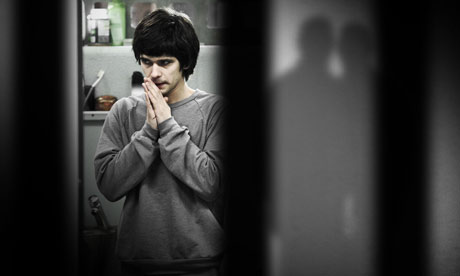
In this scene from ‘Criminal Justice’, a one off BBC drama, the main character, “Ben” gets into a fight with another prisoner. “Ben” is struggling in the fight and so the fight is ended after another prisoner, “Hooch” who we see as a sort of anti-hero, punches the in-mate that “Ben” is fighting. It then turns out that “Hooch“ had actually betrayed “Ben” which caused the fight in the first place. Prison is represented using many different techniques such as, mise-en-scene, editing, camerawork, and sound and music. These four areas work together to generally show prison to seem a lonely, dark, violent and unjust place.
The mise-en-scene is perhaps the most important factor to show the representation of prison in this extract because mise-en-scene is what creates verisimilitude. The setting in the extract is very plain with dull colours of grey and light blue. The prison walls match the same colour as the in mates clothes, however character is established as the clothes of the villain is slightly darker than the rest. This suggesting that he is different to everyone else, and he stands out. The lighting in the mise-en-scene is important, as there are lots of shadows. The group with "Ben" approaches are stood in a dark shadowed corner, and when the villainous character is speaking there are shadows on half of his face to build up enigma and suspense. The colour scheme is focused on more when the scene moves on to the fight starting and the villain takes a red chair to sit on and watch the fight. Everyone else is standing which again supports the idea that he is different and more authoritive than the other prisoners, and the red colour suggests danger. Costume is also important in this extract, because the bald character is made to look 'thuggish' through his appearance and clothes. He has a shaved head and is wearing a hoodie, which we immediately associate with anti-social, thuggish personalities. He also doesn't speak, which again builds enigma and suggests mystery, and danger. The most obvious is the fact that he is involved in the fight on the timid looking "Ben", which could suggest a sort of bullying, and the fact that he is fighting also supports the "thug" representation, which is commonly associated with prisons. "Hooch" is wearing a cardigan, which supports the idea of him being old, and with age comes wisdom. The policeman at the far end of the hall is shown to be wearing a very clean, white shirt, and he looks smart and well respectable. However, this is ironic because he is infact a corrupt cop, and keeps quiet about the fight that has taken place. Overall the set design is a very stereotypical prison, plain place, which is enclosed and seems like a very isolated place.
Editing is probably the second most important factor to show how prison is represented in this scene. The editing also helps to establish character, as the first shot of "Hooch" is shown in a light room whilst in contrast it shows the other villainous characters in the dark corner. This suggests that there is a certain degree of safety in "Hooch". Most of the shots are filmed with a shaky hand held camera, and there is more shaking whenever "Ben" is in the shot, this could represent his fear, or nervousness in this confrontation. The villain character is less steady, but it begins to become shakier when he becomes more angry. There are lots of deep focus used to direct the viewers attention to the important features, such as the reactions in certain parts of the scene, like when you can see the fight going on in the foreground, and then in the background un focused you can see the policeman stood watching, doing nothing at all.
Another aspect is the camerawork. The first shot is a tracking shot where the camera is postioned at one end of a corridor, and is tracking "Ben". This instantly establishes character, as you know by following "Ben" that he is the main character in the scene, and that he will be involved in something. Slightly further on in the scene there is a close up of the villain character with the phone in his hand. The phone becomes a motif at that point, and it is clear to the viewer that the scene will revolve around the phone somehow. Before the fight, there is an eyeline match from the villainous character which shows him looking at the thuggish character. This eyeline match builds enigma and suspense, and the viewer knows that something is about to happen. The fight is then filmed with a hand held shaky camera, which supports the uncertainty of the fight. "Hooch" is then showed to punch the thuggish character who is winning the fight with ease, and essentially "Hooch" saves "Ben". There is a cutaway to the policeman's reaction after this punch, and his reaction suggests that "Hooch" shouldn't have done that, and that something is wrong now. It then cuts to the villainous character's reaction, and this confirms that suggestion.
Finally, sound and music is the final factor that represents prison in the scene. The first piece of sound you hear is an eery atmospheric sound, that instantly creates tention. This builds enigma as it works with the tracking shot of "Ben" walking down the corridor. There is then amplified dialogue between "Ben" and the prison guard, it is amplified so that you can hear the speech clearly, but also hear the atmospheric sound which is still creating tention. As "Ben" walks through the hall towards the other prisoners you can hear a non diegtic, amplified sound of the phone being flicked in the villain character's hand. There is then just dialogue on its own, before the sound of the chair being moved is amplified. As you see the chair being moved, you can hear a high pitched frequency noise which again builds enigma just before the fight starts. There are then amplified punching sounds, which helps support the visual fight, whilst at the same time you can hear whilsting and jeering from the crowd of prisoners. Then the crowd noise fades out and on it's own "Hooche's" punch is amplified to suggest that it was important as it was the only thing you could hear. The next thing you can hear is non diegetic, distant prisoners laughing, which helps create verisimilitude, and supports the idea that the prison is bigger than what you can see. Then fades in the same incidental, eery non diegetic sound which is part of the score, which gives a threatening feeling.
Overall each aspect helps to represent prison in this extract, as the sound supports the camerawork in editing by making it more realistic, and creating enigma. Whilst the camerawork shows the realism and what is actually going on in the prison, and is supported by the editing. But the mise-en-scene is probably the most important as it actually creates the verisimilitude through the each aspect such as costume, lighting, acting, props and the set design.

Tuesday, 10 November 2009

Sound/Music Evaluation

Evaluation

The task was to plan and produce a 48 second piece of sound that would go with the clip of an intergalactic TVD. We used a program called garageband, which allows you to create entirely original pieces of sound, with numerous effects and tools. We planned our piece by using a sound map to show what sounds we were going to use, at exactly which times to put them, and also the volume at different stages.

I used many techniques, and one of them being, perhaps the most important was ambient sound. My ambient sounds included an alarm, I was looking to create a sense of panic, and as the first thing you could hear was an alarm, this would be creating that sense almost instantly. You can’t actually see the alarm going off at any point in the clip, so it also becomes a non-diegetic sound. Another ambient sound I put in was an outer space ‘whooshing’ sound, as if a space ship had just flown by. This was to reinforce the idea of where the clip is set, on a space ship, in outer space.

Another technique I used was dialogue. The dialogue was very important as it made up almost half of the clip. When the characters were speaking, I lowered the volume of the ambient alarm to show that although they were talking, that sense of panic still remained. I recorded the dialogue through the built in microphone on the Mac.

Once the dialogue had finished, the clip showed the main character with a sense of fear on his face. Just before the dialogue had completely finished I faded in another more dramatic ambient “whooshing” noise, fading in from silent to full volume, drowning out the alarm. I wanted to reinforce that there was a much more dangerous sense of panic other than the alarm.

Overall, I think that my sound piece was simple, yet effective. The timings were good and the effects that I have created link well with what you are watching. I am very happy with it.

Monday, 2 November 2009

Sound and Music in TVD Clip

Sound & Music in "How Not to Live Your Life"
[0:31-2:31]

At 0:31 you can hear and see diegetic sound as 'Don' begins to play the guitar and sing the song, as this happens it creates a sense of realism, as if 'Don' has actually written the song, and obviously shows he can play and sing it.

At 1:03 'Eddy's' dialogue is slightly amplified so that you can hear him trying to get 'Don's' attention, however 'Don's' singing is still the same volume so that the audience can still hear the song even though 'Eddy' is speaking. This also creates the sense that 'Don' can't hear 'Eddy' over the song.

At 1:06 'Don's' singing gets louder to signify that he is getting carried away with the song. 'Eddy's' dialogue also gets louder to keep the same sound levels as before.

At 1:31 the theme tune comes in. This is the same theme tune that is on the opening credits, and closing credits. It is also a motíf for 'Don's' cut away "What not to's".

At 1:41 when 'Don' clicks his fingers the click sound is amplified so that the audience don't miss it. This reinforces 'Don's' authority.

At 1:47 there is another example of diegetic sound, where you can see 'Don' eating in a ridiculous way, and the sound that he is making is amplified to reinforce how ridiculous his action is.

At 2:16 the noise of 'Don' closing the door is amplified, and it is also a diegetic sound, as you can see him closing the door, and also hear it.

At 2:27 the theme tune comes in again to show the end of one scene and the beginning of another. This is also kown as a sound bridge.

Wednesday, 14 October 2009

Explain how representations of family are created in the shown extract of Shameless (Series 1 Episode 5) [37.23 – 40.00]

In this lesson, we looked at how family is represented in Shameless. In this extract we find out that “Philip's” girlfriend, “Karen”, has been sleeping with “Philip's” Dad, “Frank”. “Karen”, whilst being “Philip's” girlfriend is also the daughter of “Frank's” agoraphobic girlfriend “Sheila”. This particular family in Shameless have many different representations, but the most obvious representation being shown is how dysfunctional the two families are. A dysfunctional family is a family in which conflict, misbehaviour and even abuse on members of the family occur continually and regularly, this is definitely being portrayed in the extract shown and we see it mainly showed through the plot.

The clip starts with “Frank” staggering home and a car creeping onto the screen almost stalking “Frank” on his way down the road. The camera then cuts to track “Frank” as he comes around the corner, and then the music starts to get faster and heavier as the car comes into view again, and at the same time getting faster. “Frank” stumbles onto the road and there is a long shot showing the car come behind him. “Frank” gets out of the way of the car, and the driver (still unknown at this point) crashes into the side of a parked van, this sequence shown by a series of fast cuts from different camera positions. Match on action is also used here to build a feeling of danger and show a fast pace. A hand held camera shaking cuts to a close up of “Frank's” face to show his reaction as he looks who the driver is. His expression is shock as the camera cuts to “Philip” running towards “Frank” on the floor. His expression is shock, because he realised that it is his son who attempted to run him over, and who is also running towards him with rage. These shots show a POV shot from “Frank's” perspective as he watches “Philip” run towards him, and an over the shoulder shot from “Philip's” perspective as he is running.

The next shot is the start of the fight scene where “Philip” is punching his Dad whilst he is on the floor. There are lots of short, fast cuts here between punches showing different points of view, “Philip” giving the punches and then “Frank” receiving them. Whilst the fight is going on, there are cuts to the house where “Sheila” and “Karen” are, and they realise that it is “Philip” and “Frank” having the fight. The music is still playing to build a sense of urgency from the women's point of view.

The fight is then broken up, and there are constant cuts between “Frank” and “Philip” as they are separated, the camera used is a hand held camera and is shaking quite a lot to show how distressed they both are after the fight. The fight scene reinforces the idea of the “Gallagher” family being dysfunctional, as they have just had a fight in the middle of the street.

The clip then cuts to an extreme close up of “Frank” lying on “Shelia's” sofa showing the wounds on his face after the fight. The camera, still shaking, then zooms out to show “Sheila” nursing “Franks” injuries, and after the zoom out it then becomes a two-shot. During the conversation that “Frank” and “Sheila” has, “Frank” lies to her about why “Philip” beat him up, once again showing another representation of the family, as liers.

Skins - Series 3 Ep.1 [0:00 - 5:11]

Representation of Age through editing.


Youth:


  • Rebellious

  • Reckless

  • Quick Witted

  • Irresponsible

  • Careless

  • Lack of Respect

  • Scruffy

Older Generation:


  • Figures of Ridicule

  • 'Uncool'

  • Unaspirational

  • Short Tempered

  • Boring/Dull

Youth is shown to be unified, especially when "Effy" steps out of the car, she thinks that the fact "Cook" is tricking her Dad is good, and clever. This also shows a clear division between young and old.


Editing:


- Black screen, builds anticipation & enigma
- You hear skateboard
- Long take, low level tracking shot of feet on the skateboard - cool (skill of the skateboarder) - skateboard is a token motif
- Turd: humour, lighthearted
- Low angle shot of olly in the air
- Match on action
- Low angle shot to make him seem high
- Match on action (landing)
- Still tracking
- Sparks - shows how fast he was going
- Tilt to phone
- Cut in to phone (close up)
- Drugs reference in the text
- Tilt up to face - slightly lower to look up to him
- Camera arcs as part of establishing
- Eyeline match - "Freddie" looks, then we see what he is looking at
- Reinforces rebellion
- Cuts back to "Freddie" again - mastershot
- Speeds up to fast takes (still following 180 degree rule)
- Match on action - each side of bus
- Camera unsteady to match his speed
- Static shot ("Freddie" passes through scene emphasising speed)
- Policeman - Camera steady
- Slow motion jump - appears to be a fantastic stunt
- Point of View shot - gives us "Freddie's" perspective
- Sparks - Urgency


- Homework -


- Camera cuts from "Freddie" as he is walking over to "Cook" & "JJ" (showing them in a two shot) and then back to "Freddie" again.
- This take is long as it shows the policeman in the background crash into the back of the lorry.
- Reinforcing how the older generation are perhaps ridiculed.
- Medium shot to show all three friends together (unity reinforced)
- The camera is now steady that they are all together, and also at the same level as the three lads. Showing the audience as almost being there with them.
- All three principles of continuity are used here to show the conversation going on (shot reverse shot & 180 Degree Rule), and the reactions on the faces of "Cook" and "Freddie" at what "JJ" is saying to them
- "Freddie" and "Cook" are continually shown over each other's shoulder's in this scene, and this maybe enforces how "JJ" is slightly isolated from them both, but still in the group anyway.
- Shot reverse shot is also used continually to show the conversation happening, the cuts are fast to show how quickly the conversation is going.
- There are many medium shots used to show each character individually to begin to build up a picture of their personality. "Cook" is shown drinking beer, "Freddie" is shown smoking a spliff, and "JJ" is shown eating a chocolate bar. This again reinforces how "Freddie" and "Cook" are perhaps more united due to rebellion, and "JJ" is slightly isolated too.
- Tracking shot of the car as it crashes into the bollard
- Camera then cuts to the reaction of the 3 lads.
- Then cuts to the driver of the car ("Effy's" Dad)
- He is shown to get out of the car in a rage, and constantly swearing. Reinforcing the representations of the older generation.
- An eyeline match is then used to show "Freddie" looking at "Effy"
- Over the shoulder is used to show "Effy" looking back at him.

Tuesday, 29 September 2009

Framing Guide - HW


Framing Guide


Tilt


Extreme Close Up


Close Up


Medium Shot


Long Shot


Establishing Shot


High Angle


Low Angle (Policeman)


Two Shot
Point of View
Over The Shoulder & Reverse